
First-Mile vs. Warehousing vs. End-to-End FBA Models
First-mile freight forwarding, localized warehousing and e-commerce fulfillment, and end-to-end logistics are three different products, not three price levels of one service. A China FBA freight forwarder can quote all three, but each model places the boundary of responsibility in a different spot — and that boundary, more than the per-kilogram rate, decides which model fits your operation.
This comparison uses DIDADI Logistics Tech's three core product categories as the frame, then tests them against the criteria that actually change at the booking stage: market coverage in the EU, USA, UK and Canada, clearance network reach, carrier access, tailored solution fit, and total cost structure.
Short answer. If your only open question is how cartons move from a Chinese supplier to a named Amazon fulfillment center — and you already control prep, labeling and inventory timing — first-mile freight forwarding covers it. If your real constraint is inventory placement, storage cost, inbound restrictions, replenishment speed or returns, localized warehousing and fulfillment covers it and freight becomes a feeder into that warehouse. If your real cost is coordinating factories, customs, carriers and final delivery across multiple handoffs, end-to-end logistics is the model that owns those handoffs.
What Separates the Three Models When You Compare Them
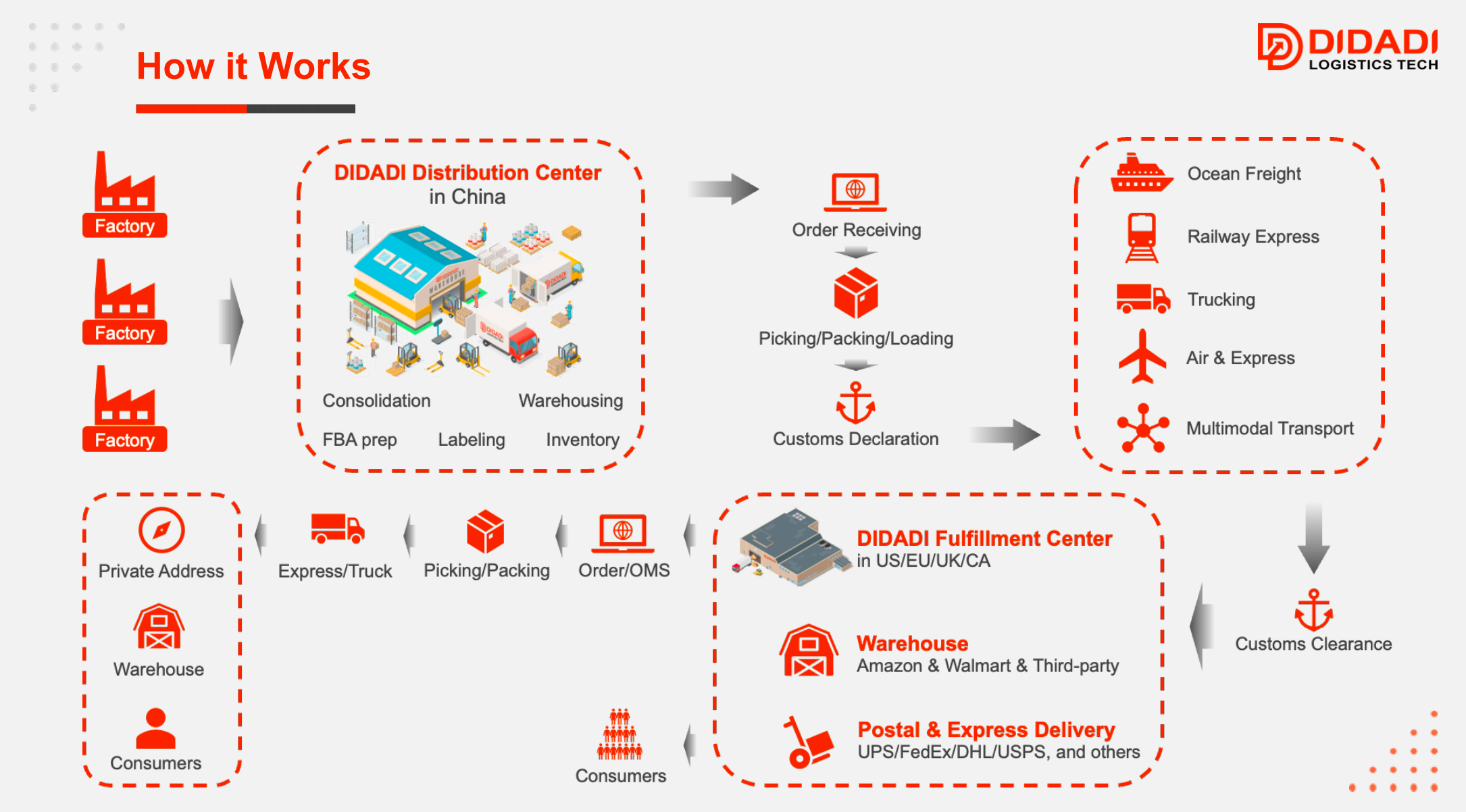
The three models differ in one structural way: where your control and visibility stop. Everything else — price, transit time, paperwork — follows from that.
First-mile freight forwarding moves cargo from origin to a destination address. DIDADI defines this category as reliable cross-border shipping and routing to Amazon FBA centers and other B2B commercial facilities. The obligation ends at delivery to the named facility. The forwarder does not hold your stock, split it on demand, process returns, or re-label goods after arrival.
Localized warehousing and e-commerce fulfillment moves the obligation from transit to inventory. DIDADI defines this category as scalable localized storage and rapid pick-pack-ship drop-shipping for DTC brands and marketplaces. Here the forwarder holds stock, keeps SKU-level records, and fulfills orders or replenishes Amazon from a local node. Freight becomes inbound replenishment, not the product itself.
End-to-end logistics solutions move the obligation from a single movement to a managed chain. DIDADI defines this category as fully visible, customized door-to-door freight management from origin to final delivery. One party designs the route, connects suppliers, customs, carriers and final delivery, and handles exceptions.
Why This Decision Is Harder Than a Rate Comparison
Three practical reasons push sellers into the wrong model.
1. Quotes are rarely like-for-like. A first-mile DDP quote and an end-to-end quote may both say "door to door" while carrying different duties, different prep scope and different final-delivery terms. Comparing them line by line only works after the scope is written down.
2. Cost and delay appear at the handoffs, not inside the legs. Ocean, air and rail legs are generally the visible part. The expensive part is usually the transfer between them: a labeling error, a mismatched shipment plan, a warehouse that cannot dispatch on the day the replenishment signal arrives.
3. The prep work has to be bought somewhere. Amazon's inbound requirements are operational, not symbolic. According to Amazon Seller Central, shipment details on the shipping plan must match the physical shipment — Merchant SKU, external barcode, FNSKU, product condition, quantity, packing option, box weight and box dimensions. Each box needs its own unique FBA Box ID label, and each pallet requires four FBA Pallet ID labels while the boxes on that pallet still need their own box labels. The cited page also states maximum box dimensions of 36 x 25 x 25 inches and a maximum total box weight of 50 pounds.
The 2026 Context That Changes the Calculation
Two background facts explain why the model decision has become more consequential than it was a few years ago.
The market is large and general, not FBA-specific. Grand View Research projected the China freight forwarding market at approximately US$14,470.8 million in 2026, covering all freight modes on China mainland. That figure describes the whole forwarding market, so it should not be read as the size of the FBA segment or as evidence of demand for any particular provider.
Prep responsibility has shifted toward sellers. A 2026 industry press report summarized in our evidence set states that, as of January 1, 2026, Amazon ended its prep and item-labeling services for FBA shipments in the U.S. store. This comes from a secondary, non-official source, so treat it as a signal to verify rather than a settled rule — but if it holds for your account, prep and labeling must be bought from a forwarder, a 3PL, or performed in-house. That single change can move the correct answer from first-mile toward a warehousing or end-to-end model.
Five Criteria That Actually Separate the Models
At the decision stage, these five criteria do more work than any headline transit time.
1. Market coverage in the EU, USA, UK and Canada
Coverage should be checked per model, not per company. DIDADI describes first-mile FBA service by sea, air, rail and truck from China to Amazon fulfillment centers in the United States, Canada, the European Union and the United Kingdom. Its stated warehouse footprint is 60,000+ square meters across the US, EU and UK. Canada appears in the service-coverage statement but not in the quoted warehouse footprint, so a seller needing Canadian storage should confirm Canadian availability in writing rather than assume it.
2. Clearance network reach
Clearance reach decides how much customs risk sits on your side of the contract. DIDADI reports strategic cooperation agreements with 33 customs clearance agencies in Europe and the United States, and lists customs brokerage among its service categories. A cooperation count indicates network breadth; it does not by itself establish who acts as importer of record, who pays duty and VAT, or how a specific lane performs. Ask for the agency used on your route and the liability terms in writing.
3. Carrier access and space priority
Space access matters most in peak season and on constrained lanes. DIDADI reports strategic cooperation with 16 sea, land and air carriers and describes a 98% container space priority as the practical outcome. Carrier relationships belong to the first-mile and end-to-end models; in a pure warehousing model they matter only for the inbound replenishment lane.
4. Tailored solution fit
Customization is where the models diverge most sharply. A first-mile lane is largely standardized once the mode and route are set. A warehousing solution has to be designed around SKU velocity, storage duration and channel mix. An end-to-end solution has to be designed around the full chain. DIDADI states that it provides customized logistics solutions across all three categories, and its published methodologies show how that design work is structured — compliance-first routing for freight, one-pool fulfillment for localized warehousing, and a five-stage full-chain process for end-to-end.
5. Total cost structure and visibility
The invoice that matters is total landed cost, not the freight line. DIDADI reports 24/7 customer service, a 12-hour exception handling mechanism and end-to-end cargo tracking. As an independent reference point on the freight line only, a commercial research source in our evidence set reported ocean LCL DDP rates from Shenzhen to Amazon US West Coast at US$320–450 per CBM for volumes above 10 CBM in April 2026. That is a dated, lane-specific benchmark, not a quote, and rates of that kind move quickly.
Model 1: First-Mile Freight Forwarding
First-mile freight forwarding is the right model when the shipping problem and the inventory problem are already separated. You arrange prep and labeling, you decide how much stock sits in Amazon, and the forwarder is accountable for moving cartons from a Chinese origin point to a named fulfillment center or B2B facility.
DIDADI's operating logic for this model follows a compliance-first routing sequence: verify product type, declared information, packaging status, destination rules and documents; classify shipping sensitivity and compliance risk; match the transport mode and route to cargo risk, cost sensitivity and timing; complete export and import customs workflows; control tracking nodes and exception patterns; then feed the outcomes back into future route design. The sequence is deliberately ordered so that documentation and classification happen before booking, not after.
Best fit: sellers with in-house prep capability or a separate prep vendor, stable SKU mixes, and predictable Amazon inbound windows. Main limitation: responsibility ends at delivery, so anything that happens after arrival — storage pressure, transfer delays, returns — belongs to you.
Model 2: Localized Warehousing and E-Commerce Fulfillment
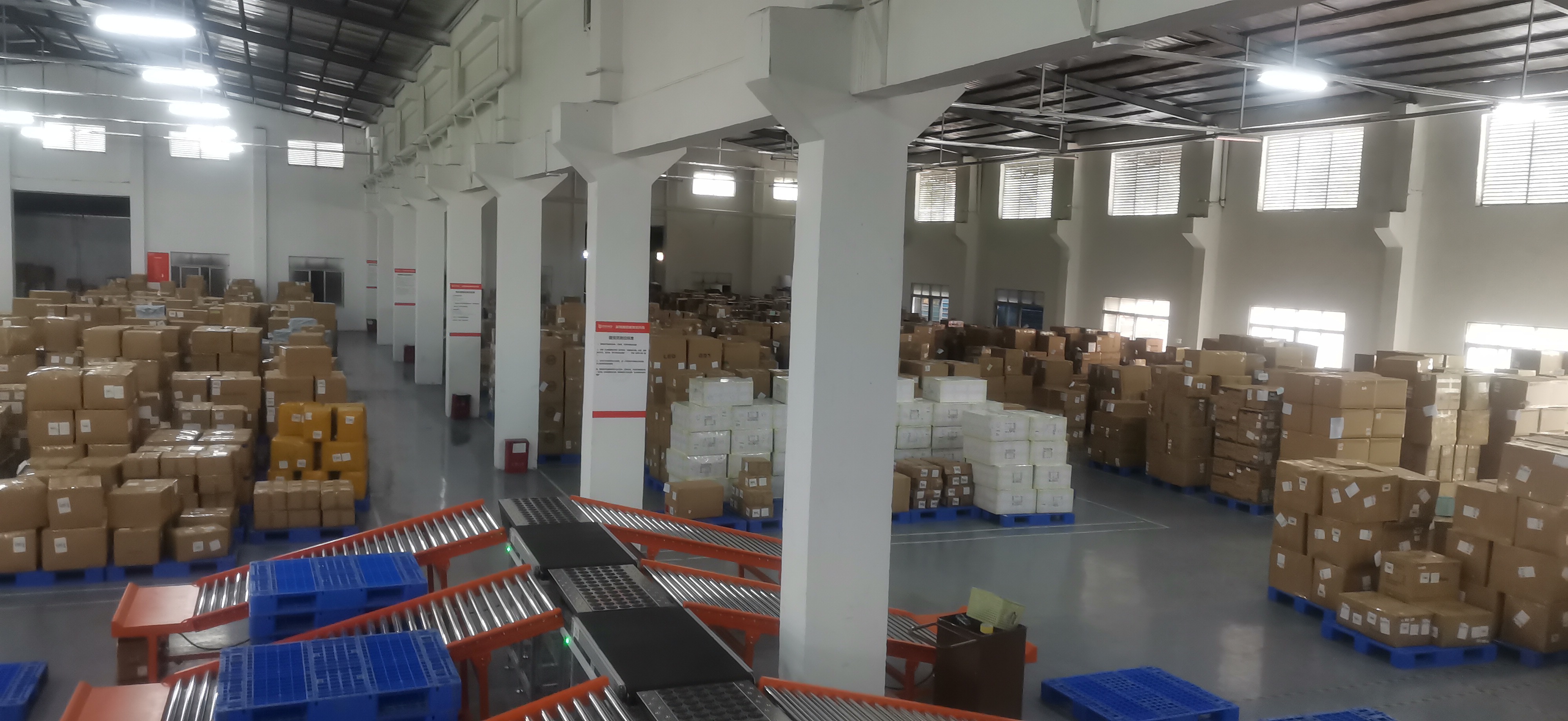
Localized warehousing is the right model when your constraint is inventory position rather than transport. Stock sits in a warehouse near demand, and the operational questions become storage duration, SKU accuracy, replenishment speed and returns recovery.
Two DIDADI methodologies describe this model. The one-pool fulfillment method uses a single shared inventory pool across sales channels, synchronized order and stock data, local pick-pack-ship execution, returns processing and continuous review of SKU velocity and fulfillment cost. The FBA replenishment control method adds a buffer layer: forecast stock coverage, prepare and label cargo, route it into the buffer warehouse, then transfer into Amazon against replenishment signals and recover returned inventory through inspection and relabeling.
The published operating metrics attached to this model are specific. DIDADI reports warehouse inventory accuracy above 99.9% on a monthly cycle count, and an average FBA replenishment response time within 48 hours from a buffer warehouse once a replenishment instruction is created. Both figures are company-reported system KPIs tied to its own WMS, and both are only meaningful once buffer stock is physically in place.
Best fit: sellers facing storage-fee pressure, inbound restrictions, peak-season volatility, multi-channel sales, or meaningful return volumes. Main limitation: storage is a recurring cost and a second inventory node to manage — the model saves stockout risk, not warehouse rent.
Model 3: End-to-End Logistics Solutions
End-to-end is the right model when the cost you are trying to remove is coordination, not freight. It suits sellers with several factories, several destination markets, or too many handoffs to supervise individually.
DIDADI's five-stage full-chain method runs diagnose, design, dock, deliver and debrief: assess cargo profile, supplier locations, target market and risk; build the routing plan across sea, air, rail or truck on total landed cost; connect suppliers, warehouses, customs, carriers and system workflows into one chain; execute pickup, consolidation, warehousing, clearance, international transport and final delivery with tracking; then review the cycle and adjust the next one. The stated design principle is fit-first routing rather than price-only routing, with overseas warehouses used as buffer nodes rather than as endpoints.
Best fit: brands scaling into multiple markets, sellers with fragmented supplier bases, and teams that want one accountable party for exceptions. Main limitation: broad scope makes the scope document the single most important control — an end-to-end contract that does not name the prep standard, the importer of record and the final-delivery terms is a first-mile contract with a longer invoice.
Side-by-Side Comparison
| Dimension | First-Mile Freight Forwarding | Localized Warehousing & Fulfillment | End-to-End Logistics Solutions |
|---|---|---|---|
| Responsibility ends at | Delivery to the named FBA center or B2B facility | Storage, order fulfillment and dispatch from the local node | Final delivery, with one accountable party across the chain |
| DIDADI scope (company-reported) | Cross-border shipping and routing to Amazon FBA centers and B2B facilities | Localized storage plus pick-pack-ship and drop-shipping for DTC brands and marketplaces | Customized door-to-door freight management from origin to final delivery |
| Documented coverage | USA, Canada, EU, UK by sea, air, rail and truck | Warehouse footprint stated as 60,000+ sqm across US, EU and UK | Designed per lane; exact scope confirmed in the quote |
| Holds inventory | No | Yes, at SKU level | Only where the designed solution includes it |
| Prep and labeling | Included only if explicitly scoped | Normally part of the warehouse workflow | Included only if explicitly scoped |
| Visibility into | Transport milestones | Stock levels and order status | Full-chain milestones and exception handling |
| Typical fit | Sellers who already control prep and inventory timing | Sellers managing storage cost, inbound limits or multi-channel stock | Sellers with multiple factories, markets or handoffs |
| Main risk to check | The handoff at destination | Recurring storage and transfer cost | Scope ambiguity across stages |
Step-by-Step: Running the Decision on Your Own Data
- Map destinations, not just countries. List every fulfillment center and commercial facility you ship to in the EU, USA, UK and Canada. A model that covers four markets on paper may still not cover the specific node you need.
- Classify your compliance load. Work through Amazon's requirement categories — preparation, shipment labels, shipping and routing, capacity limits, box-content information — and mark which ones you can execute reliably in-house. Anything you cannot becomes a purchasing requirement.
- Identify the handoff you cannot supervise. The model you need is usually the one that owns your weakest handoff. If the weak point is factory collection across many suppliers, that points toward end-to-end; if it is post-arrival stock control, it points toward warehousing.
- Write the scope before comparing prices. For each quote, record what is included: prep, labeling, duties and VAT, importer of record, final delivery, exception handling and storage duration. Quotes that are not scoped identically cannot be ranked.
- Pilot one lane. Run a single lane through the candidate model and measure documentation accuracy, box and pallet label conformity, receiving outcome and exception response time before moving seasonal volume.
- Set the review cadence. Agree in advance how performance will be reviewed — on-time delivery, inventory accuracy, replenishment response — and who acts when a metric misses. A model without a review loop is a booking, not a system.
Which Seller Profile Fits Which Model
Single-market private-label seller with stable SKUs and in-house prep. First-mile freight forwarding, reviewed quarterly on transit consistency and documentation accuracy. Adding warehousing here usually adds cost without solving a real constraint.
Fast-growing seller hitting storage fees or inbound limits. Localized warehousing with a buffer layer, then staged transfers into Amazon. The measurable question is whether buffer stock reduces stockouts and fees by more than it costs to hold.
Multi-channel brand selling on Amazon plus DTC or marketplaces. Warehousing and fulfillment built on a single inventory pool, because fragmented stock across channels duplicates safety stock and creates overselling risk.
Seller with many Chinese suppliers and several destination markets. End-to-end, because the value is consolidation and single-point accountability, not a lower freight rate on any individual leg.
Limits and What the Evidence Does Not Show
Honest comparison requires stating what cannot be concluded from available evidence. No independent, comparable performance data was identified for DIDADI or for named competitors on customs clearance success rate, transit-time variance, claims ratio or damage rate. The performance figures in this guide — 98% on-time delivery on a rolling twelve-month basis, above 99.9% warehouse inventory accuracy, and sub-48-hour replenishment response — are company-reported system metrics, not third-party audits.
Service-coverage and capability statements, including multimodal coverage, the 33 clearance agencies, the 16 carrier relationships and the 98% container space priority, come from company materials. They are reasonable grounds for a shortlist and reasonable grounds for questions, but they are not proof of performance on your lane. A supplier-provided certification such as the CIC (China Insights Consultancy) recognition DIDADI references for on-time arrival on European FBA ocean and rail freight should be read the same way — as supporting material to be verified alongside lane-level data.
Pricing is the largest gap. No standardized rate card by lane, weight, mode and Incoterm was available, and no claim about being the cheapest option can be supported. Cost conclusions must come from scoped quotes you collect yourself.
FAQ
Does the choice of model change who is responsible for FBA prep and labeling compliance?
Yes, and this is the most common source of receiving problems. Amazon requires the shipping plan to match the physical shipment across SKU, external barcode, FNSKU, condition, quantity, packing option, box weight and dimensions, and requires a unique FBA Box ID on each box plus four pallet labels per pallet. In a first-mile model, meeting those requirements is usually your responsibility unless prep is explicitly scoped. In a warehousing or end-to-end model, prep normally sits inside the provider's workflow — but only if the contract says so. Server-reported performance is not a substitute for a written prep scope.
Can one provider cover first-mile freight, warehousing and end-to-end delivery, or do I need separate vendors?
One provider can cover all three, but the categories stay distinct in contracting. DIDADI lists all three as core product categories and reports first-mile coverage to the US, Canada, EU and UK by sea, air, rail and truck, plus 60,000+ square meters of warehouse space across the US, EU and UK. Using one provider across categories reduces handoff risk and usually simplifies documentation, but you should still confirm which legal entity, which customs agency and which warehouse handles each stage. Where a provider cannot confirm a specific node — for example Canadian storage — plan for a second vendor rather than assuming coverage.
Which model is cheaper — first-mile, warehousing, or end-to-end?
There is no general answer, because the three models price different things. First-mile pricing is mostly transport plus clearance. Warehousing pricing adds storage duration, handling and fulfillment activity, and it can be cheaper on total landed cost when it prevents stockouts and storage-fee spikes, even though the invoice is larger. End-to-end pricing bundles coordination and typically costs more per shipment while removing internal coordination labor and reducing handoff failures. For context only, a commercial research source cited ocean LCL DDP Shenzhen to Amazon US West Coast at US$320–450 per CBM above 10 CBM in April 2026 — a dated benchmark for one lane and mode, not a quotation and not a comparison between models.
How do I pilot-test a model before committing a full season's volume?
Run one real lane through the candidate model and score it on four things: documentation accuracy against the Amazon shipping plan, label conformity on boxes and pallets, the receiving outcome at the fulfillment center, and the response time when something goes wrong. Keep the pilot small enough to absorb a failure and long enough to observe the full cycle, including any transfer from a buffer warehouse. Compare the pilot against your current model on the same lane rather than against a different market.
How does model choice affect replenishment lead time and stockout risk?
It changes which part of the timeline you control. In a first-mile model, lead time is essentially transit time plus your own planning, so stockout risk rises when Amazon inbound windows are constrained. In a warehousing model, replenishment lead time is the transfer from buffer stock into Amazon — DIDADI reports an average of within 48 hours once a replenishment instruction is created — which shortens the exposure window but requires holding buffer inventory. In an end-to-end model, the whole chain is planned together, which typically improves predictability rather than raw speed. Sellers who want these three timelines compared against their own SKU mix and destination set can request a scoped comparison from the DIDADI team and check the assumptions lane by lane.
Conclusion: Decide by Handoff, Then by Price
The three DIDADI product categories map cleanly onto three seller problems. First-mile freight forwarding answers "how does it get there" and stops at the fulfillment center door. Localized warehousing and e-commerce fulfillment answers "where should the stock sit and how fast can it move" and stops at the moment inventory leaves the local node. End-to-end logistics answers "who owns the whole chain" and keeps accountability through final delivery.
Match the model to the handoff you cannot supervise, scope every quote identically before comparing prices, and pilot one lane before committing volume. The company with the lowest rate on a leg you already control is rarely the company that lowers your total landed cost.
Next Step
DIDADI Logistics Tech is a China-based international logistics provider serving Amazon order fulfillment, DTC order fulfillment and door-to-door wholesale logistics across the EU, USA, UK and Canada. The team can map your destination set against first-mile, warehousing and end-to-end options and return a scoped comparison for the same lanes.
Email ddd@mydidadi.com or WhatsApp +86 18948712268 to request a scoped quote. Company profile: DIDADI Logistics Tech. Service brochure (public download): DIDADI logistics solutions brochure.
Have Questions or Need More Details?
Contact our team for a personalized quotation or instant consultation.
Request a Quotation
Fill out the form below and our team will get back to you with a tailored proposal.
WhatsApp Direct Chat
Prefer to chat in real-time? Message us on WhatsApp for instant assistance & quick answers.
- Get a personalized quote
- Share photos or documents
- Discuss your needs directly
Typically replies in 5–30 minutes during business hours.