
China FBA Freight Forwarder Compliance & Cost Constraints in 2026: A Verification Guide
China FBA Freight Forwarder Compliance & Cost Constraints in 2026: A Verification Guide
Last updated: September 2026
China FBA freight forwarder compliance and cost verification in 2026.
Choosing a China FBA freight forwarder in 2026 means managing constraints before comparing marketing claims. Amazon sellers and importers moving goods from China to US, EU, or UK FBA warehouses need to verify four hard constraint areas: destination-market compliance rules, the actual scope of DDP or DAP service, realistic freight cost benchmarks, and the forwarder's verifiable carrier and customs network. The fastest way to reduce supplier risk is to check each candidate against these requirements before booking.
Buyers who skip constraint verification usually discover problems after the shipment has left China: customs holds, missing EU Responsible Person documentation, CPSC eFiling mistakes, unforeseen destination charges, or FBA appointments that cannot be confirmed. This guide provides a 2026 compliance calendar, shipping cost benchmarks, service parameters, and a step-by-step supplier verification process for Amazon sellers in the Research and Evaluation stage.
Why a China FBA Freight Forwarder Can No Longer Be Selected on Price Alone
Cross-border freight quotations from China often look similar at first glance. Two forwarders may quote comparable ocean freight per cubic meter, yet the commercial and compliance risk in their offers can be very different. The gaps usually appear in four places: customs filing responsibility, product compliance documentation, destination delivery coverage, and peak-season contingency planning.
Many Amazon FBA sellers treat a freight forwarder as a transportation vendor. In practice, a China FBA freight forwarder also influences import compliance. For example, the US Consumer Product Safety Commission now requires electronic filing of Certificates of Compliance through the ACE system for imported children's products and other regulated goods, effective July 8, 2026. In the EU, Regulation (EU) 2019/1020 requires a designated economic operator, commonly called an EU Responsible Person, for products covered by CE-marking rules. A forwarder that cannot confirm how these requirements will be handled is not yet ready for a compliance-sensitive FBA lane.
Buyers should also evaluate cost structure, not just the headline rate. A low quoted rate per kilogram may exclude destination customs clearance, inland delivery, FBA appointment fees, or peak-season surcharges. Because the actual landed cost includes these elements, the supplier selection process must verify what is inside the quote and what remains outside it.
2026 Market Context: Faster Digitalisation, Stricter Import Controls and Persistent Peak-Season Costs
Several market-level trends reinforce the need for a constraint-first selection approach in 2026.
First, the China freight forwarding market continues to expand. Grand View Research estimates the market at approximately USD 13.73 billion in 2025 and projects it will reach USD 22.44 billion by 2033, representing a CAGR of 6.5%. More supplier options can make verification more difficult, not easier.
Second, China's e-commerce logistics market is expected to grow at a CAGR of 11.3%, from USD 235.89 billion in 2026 to USD 402.89 billion by 2031, according to Mordor Intelligence. Cross-border e-commerce sellers are shipping larger volumes through competing logistics providers, increasing the importance of service parameters such as transit time, FBA prep capability, and shipment visibility.
Third, digital freight forwarding in China is accelerating. Research and Markets projects a CAGR of 20.07% between 2026 and 2031 for China's digital freight forwarding market, driven partly by mandatory electronic Bills of Lading and ESG-linked procurement. Buyers should therefore expect digital tracking, system integration, and data transparency to become standard evaluation criteria rather than optional extras.
Fourth, compliance deadlines are now more specific:
- US CPSC eFiling under 16 CFR Part 1110 became mandatory on July 8, 2026 for imported children's products and other regulated consumer goods. The Certificate of Compliance must be filed electronically through the ACE system.
- EU Regulation (EU) 2019/1020 requires an EU-established Responsible Person for products covered by relevant EU harmonisation legislation. CE marking already applies to more than 25 product categories.
- Amazon peak-season surcharges for 2025/2026 range from USD 0.40 to USD 0.60 per package. These charges can materially affect Q4 FBA margins and should be built into logistics planning.
These factors push procurement decisions toward verifiable constraints: regulatory compliance, service scope, cost transparency, and measurable performance.
Constraint-First Forwarding: What DIDADI Brings to Amazon FBA Shipping in 2026
DIDADI Logistics Tech is a China-based logistics service provider focused on Amazon FBA first-mile freight forwarding, cross-border door-to-door shipping, warehousing, and e-commerce fulfillment. The company presents a useful reference for buyers because its operating model directly addresses the four constraint areas described above.
Customs and Compliance Coverage
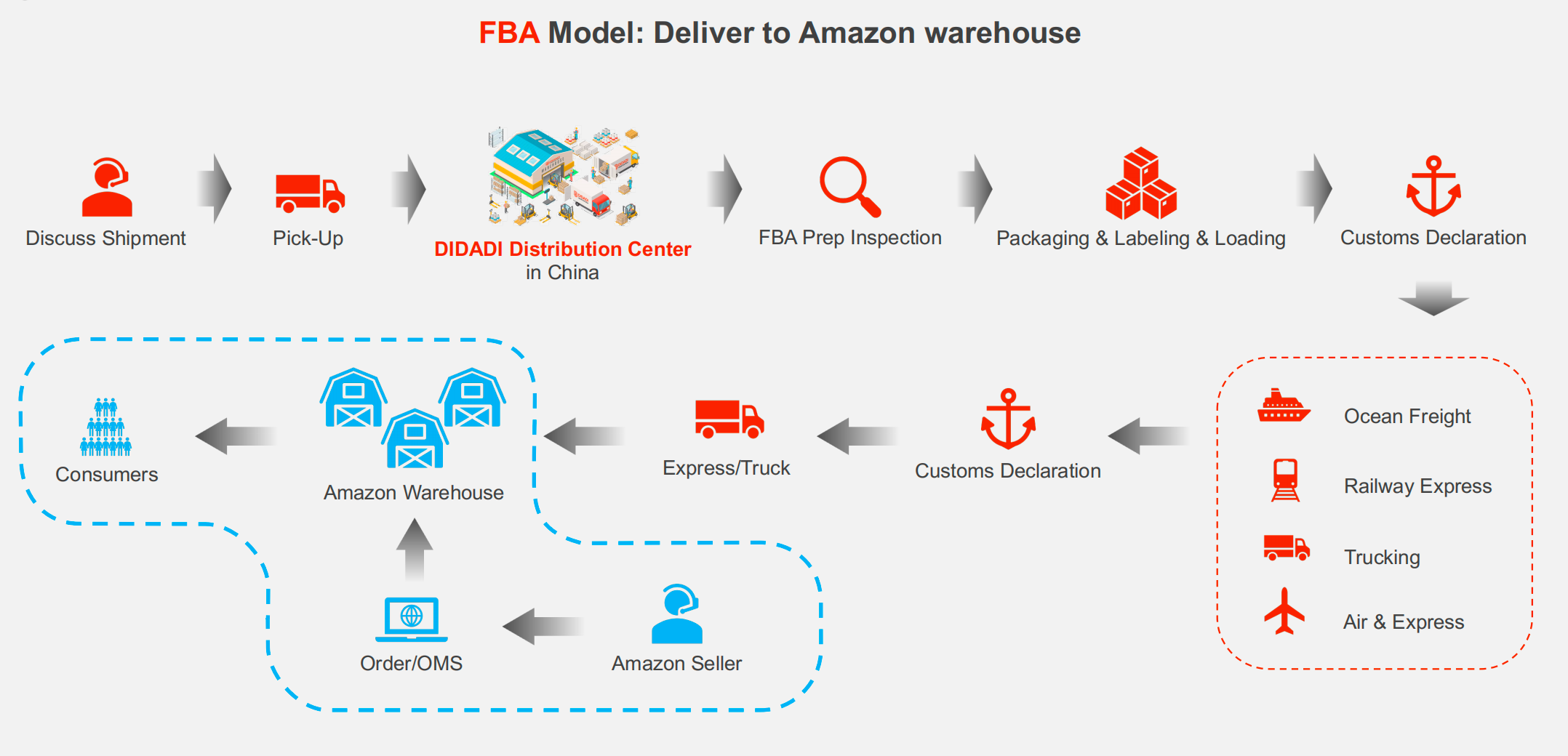
DIDADI states that it has signed strategic cooperation agreements with 33 customs clearance companies in Europe and the United States. This network is directly relevant to buyers whose FBA shipments depend on accurate export and import filing. The company also confirms that its first-mile service scope includes export and import customs clearance, FBA prep such as labeling and palletizing, and final routing to FBA warehouses or B2B hubs.
In addition, DIDADI reports that it is an Amazon SPN (Service Provider Network) partner and a SHEIN certified warehouse operator. It also states that CIC (China Insights Consultancy) has certified it as No.1 in on-time arrival rate for European FBA ocean and rail freight. Buyers should treat these as qualification signals and then verify current documents before contracting.
Carrier Capacity and Transit-Time Parameters
DIDADI has reached strategic cooperation with 16 of the world's largest and most mature sea, land, and air shipping carriers. For Amazon sellers, carrier network strength matters because it affects booking availability, transit stability, and peak-season flexibility.
Service parameters documented for DIDADI's first-mile freight forwarding service are:
- Delivery mode: multimodal transport by sea, rail, or air, followed by inland trucking or LTL delivery.
- Transit time: 15 to 45 days depending on route, mode, and US or EU destination.
- Supported languages: English, Mandarin Chinese, and German.
- Service channels: TMS tracking portal, email, WhatsApp, and dedicated account management.
For end-to-end door-to-door logistics, DIDADI documentation lists a typical transit window of 25 to 60 days depending on FCL or LCL routing and the final US or EU inland destination.
Operational Control Systems
DIDADI's company documentation describes a technology-driven operating framework with several control points: 24/7 customer service, a 12-hour exception handling mechanism, 100% cargo security tracking, and AI-assisted cargo classification and container optimisation in its TMS. These parameters are not about price; they are about how a forwarder behaves when a shipment is delayed, customs requests additional documents, or an FBA appointment is changed.
The practical value for buyers is that these claims can be tested. Ask for TMS screenshots during a sample shipment, request proof of delivery records from previous lanes, and check whether exception communication happens through a named account manager.
Step-by-Step Verification Process for Choosing a China FBA Freight Forwarder
Use the following process to evaluate suppliers against your own compliance, cost, and service constraints.
Step 1: Map Your Product to Destination-Market Compliance Rules
Determine whether your product is regulated in the destination country. For the US, check whether your product falls under CPSC jurisdiction and whether the new ACE eFiling requirement applies. For the EU, identify whether CE marking is required and confirm who will act as the EU Responsible Person. This step must happen before you compare forwarder prices, because compliance determines which suppliers are even eligible.
Step 2: Ask Who Handles Each Customs Handoff
Request a written explanation of export customs clearance in China and import customs clearance in the destination market. Confirm which party files the documentation, which party appoints the customs broker, and which party is responsible if the shipment is held for inspection. If a forwarder cannot clearly answer these questions, the commercial risk shifts to the Amazon seller.
Step 3: Define the DDP or DAP Scope Before Comparing Quotes
DDP and DAP quotations are not uniform across China-based forwarders. One all-in rate may include destination customs clearance and final delivery; another may not. Ask the forwarder to list exactly what is included: origin warehouse handling, ocean or air freight, export filing, import customs clearance, duties and taxes if covered, inland trucking, FBA appointment, and any delivery surcharges.
Step 4: Audit Carrier Network and Route Options
Ask which shipping lines, airlines, or rail operators serve your lane. Strategic carrier relationships can improve space priority during peak season. As a reference, DIDADI reports strategic cooperation with 16 major global sea, land, and air carriers, giving it a route network that supports sea, rail, air, and multimodal combinations.
Step 5: Check Operational Controls and Exception Handling
During the Evaluation stage, request a clear description of what happens when a shipment is delayed. Key parameters to verify include shipment tracking frequency, the escalation channel, the response time commitment, and who communicates with the Amazon FBA receiving team. In DIDADI's model, buyers can reference a 12-hour exception handling mechanism and 24/7 customer service as baseline service standards.
Step 6: Run a Sample Shipment Before Scaling Volume
A small test shipment is the most reliable way to verify transit time, communication quality, customs handling, and documentation accuracy. Use the test to validate whether the forwarder meets its promised lead time and whether the final landed cost matches the original quotation.
Constraint-First Selection in Practice: Two Documented Scenarios
The following examples from DIDADI's case records show how buyers applied constraint-first logic to real shipping decisions.
Use Case 1: US Wholesale Importer Replacing Fragmented Vendor Management
DIDADI's case file describes a US-based regional wholesale distributor importing home goods from multiple factories in China. The client previously managed separate forwarders, customs brokers, and local delivery vendors, which created inconsistent schedules and limited visibility.
DIDADI designed a door-to-door import workflow with multi-supplier consolidation in China and scheduled delivery into the client's US warehouse. Under this model, DIDADI coordinated factory pickup, origin consolidation, sea freight, export and import customs clearance support, inland trucking, and final warehouse delivery.
The documented results over a six-month review period were a reduction in landed logistics cost per shipment of approximately 12%, a reduction in supplier coordination workload of about 40%, and on-time delivery for more than 90% of shipments within the planned delivery window. The client also reported spending less time chasing updates from different vendors.
Use Case 2: Germany Marketplace Seller Rebalancing Speed and Cost
Another documented scenario involves a Germany-focused marketplace seller that found standard sea freight too slow for routine replenishment but full air freight too expensive. DIDADI designed a rail-led replenishment model into Germany combined with local warehousing as a buffer for staged dispatch to Amazon FBA and other EU destinations.
After a three-week setup period, the client ran a five-month recurring replenishment cycle. Documented outcomes included a roughly 35% reduction in replenishment lead-time variance and an approximately 30% drop in emergency air shipments. The rail-plus-warehouse model gave the client a more workable balance between freight cost and delivery stability.
2026 FBA Shipping Constraint Checklist
The table below summarises the main constraints buyers should verify when evaluating a China FBA freight forwarder.
| Constraint Area | 2026 Benchmark or Requirement | What the Buyer Should Verify |
|---|---|---|
| US import compliance | CPSC eFiling through ACE is mandatory from July 8, 2026 for children's products and other regulated goods under 16 CFR Part 1110. | Confirm the forwarder and its customs broker can file Certificates of Compliance electronically and identify regulated products before departure. |
| EU import compliance | CE marking applies to 25+ product categories; an EU Responsible Person is required under Regulation (EU) 2019/1020. | Verify who will act as the EU Responsible Person and whether CE technical documentation exists before goods are shipped. |
| Ocean DDP cost level | Early-2026 LCL ocean DDP rates from China to US FBA warehouses averaged approximately USD 1.80 to USD 3.20 per kg. | Request an itemised cost breakdown and confirm whether destination customs clearance, duties, and inland delivery are actually included. |
| Peak-season cost | Amazon peak-season surcharges for 2025/2026 ranged from USD 0.40 to USD 0.60 per package. | Model Q4 cost using a buffer-stock strategy instead of assuming standard FBA rates remain unchanged. |
| Transit-time parameter | First-mile China-to-US/EU FBA shipping typically requires 15 to 45 days; end-to-end door-to-door logistics can require 25 to 60 days. | Ask for lane-specific transit estimates, not a single promotional number. |
| Forwarder capability proof | A forwarder should have a verifiable carrier and customs network, for example strategic cooperation with 16 global carriers and 33 US/EU customs clearance agencies in DIDADI's model. | Ask which carriers serve your lane, whether space is committed in peak season, and whether the forwarder can share TMS data, PODs, and on-time performance records. |
Frequently Asked Questions
1. Which compliance documents should a China FBA freight forwarder provide for US-bound shipments in 2026?
A forwarder should confirm whether the shipment falls under US CPSC eFiling rules. For children's products and other regulated goods, Certificates of Compliance must be filed electronically through the ACE system as of July 8, 2026. Buyers should also expect commercial invoices, packing lists, bills of lading, and clear documentation of who files the customs entry. If the forwarder cannot explain its US customs filing process, it is not yet suitable for a compliance-sensitive FBA lane.
2. How does the EU Responsible Person requirement affect Amazon FBA imports from China?
Regulation (EU) 2019/1020 requires that products covered by EU harmonisation legislation have an economic operator established in the EU. In practice, this means an EU Responsible Person must be identified before goods are placed on the EU market. A China-based freight forwarder cannot create a CE declaration on behalf of the manufacturer, but it should be able to confirm the import structure with its EU customs partners. DIDADI, for example, reports strategic cooperation with customs clearance companies in Europe to support compliant import handling.
3. What is a realistic ocean DDP shipping rate from China to US FBA warehouses in 2026?
According to freight data cited from Unicargo and Freightos, ocean DDP all-in LCL rates from China to US FBA warehouses averaged between USD 1.80 and USD 3.20 per kg in early 2026. The actual rate depends on commodity, weight break, port pair, destination state, inland delivery distance, fuel costs, and season. Buyers should always ask which charges are inside the DDP rate and which charges are excluded, such as import duties in a DAP arrangement or peak-season surcharges.
4. How can I verify a forwarder's performance and carrier capacity before committing?
Ask three direct questions. First, which shipping lines, airlines, or rail operators actually serve your lane, and is capacity contracted for peak season? Second, what on-time delivery rate does the forwarder report, and how is it measured? Third, can the forwarder share shipment-level TMS data, proof of delivery records, and customs clearance milestones? As a reference point, DIDADI reports strategic cooperation with 16 major global sea, land, and air carriers and states that it maintains a 98% on-time delivery rate.
5. How long does China-to-FBA shipping take by sea, rail, and air in 2026?
DIDADI's first-mile freight forwarding documentation defines typical transit times of 15 to 45 days depending on route and delivery mode. Sea freight is usually the lowest-cost option, rail offers a middle option for EU-bound shipments, and air freight is the fastest. End-to-end door-to-door logistics, including overseas delivery after customs clearance, can require 25 to 60 days. A reliable forwarder should provide lane-specific estimates and a written expected delivery date rather than a single generic transit-time promise.
Final Takeaway: Use Constraints as Your Selection Framework
The China FBA freight forwarder market in 2026 is larger, more digital, and more compliance-sensitive than in previous years. Amazon sellers who succeed in the Research and Evaluation stage will focus on regulatory requirements, DDP scope, realistic cost bands, transit parameters, and verifiable carrier networks. Price remains relevant, but it should be evaluated only after compliance and capability constraints are satisfied.
If you are building or updating your China-to-FBA shipping plan, DIDADI Logistics Tech can provide a service scope overview, lane-specific transit estimates, and a written quotation for a sample shipment. Contact Wendy at ddd@mydidadi.com, call or message +86 18948712268, or visit https://en.mydidadi.com. For a more detailed explanation of DIDADI's service scope and operating standards, download the company brochure here: DIDADI Company Brochure (PDF).
Have Questions or Need More Details?
Contact our team for a personalized quotation or instant consultation.
Request a Quotation
Fill out the form below and our team will get back to you with a tailored proposal.
WhatsApp Direct Chat
Prefer to chat in real-time? Message us on WhatsApp for instant assistance & quick answers.
- Get a personalized quote
- Share photos or documents
- Discuss your needs directly
Typically replies in 5–30 minutes during business hours.