
China FBA Freight Forwarder with Customs Clearance: A 2026 Compliance-First Selection Guide
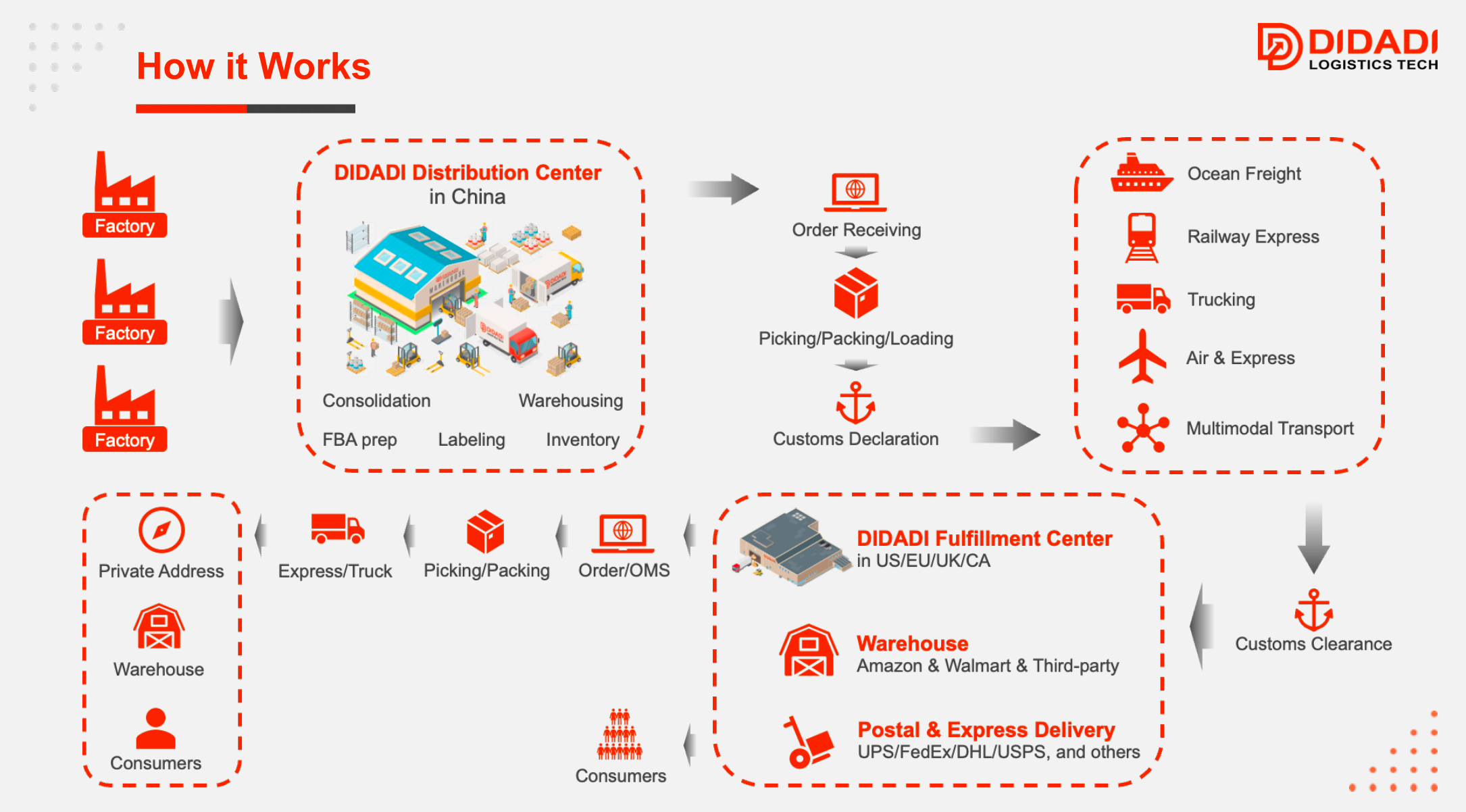
Figure 1: End-to-end China FBA freight forwarding with customs clearance and delivery.
China FBA Freight Forwarder with Customs Clearance: A 2026 Compliance-First Selection Guide
When an Amazon seller in the United States or the European Union replenishes inventory from China, the critical question is not simply "which freight forwarder moves boxes fast," but "which China FBA freight forwarder can manage customs clearance, compliance, and delivery to Amazon FBA as a single accountable process." This guide explains what customs clearance support means in FBA shipping, which compliance obligations affect China-to-US and China-to-EU routes, how to evaluate a forwarder's capabilities, and when door-to-door DDP services reduce risk.
The Problem: Why FBA Shipments Fail Beyond Freight Movement
FBA shipments from China involve more than choosing between sea, rail, and air. Even when a container arrives on time, a shipment can be delayed at customs, rejected by the destination authority, or blocked by Amazon inbound requirements. Sellers often discover that their forwarder handles only the China export leg and leaves destination clearance, FBA appointment booking, and compliance documentation to the seller or a separate broker.
Customs clearance for Amazon FBA is a defined, document-heavy process. It includes export declaration in China, import clearance at the destination, confirmation of shipment value and product classification, and—where applicable—submission of certificates or safety data. In addition, Amazon requires delivery appointments and compliance with its own packaging, labeling, and carton requirements. A forwarder that does not control these steps can create hidden costs, lost time, and stockout risk.
Industry Background: Trade Compliance Is Tightening in 2026
Two regulatory shifts make customs clearance competence more important for China FBA sellers in 2026.
First, for goods entering the European Union, Market Surveillance Regulation (EU) 2019/1020 requires that many product categories have a designated EU "Responsible Person" established inside the EU. This applies to CE-marked goods across 25+ categories, and customs authorities increasingly check for this economic operator before releasing goods. FBA sellers who do not have an EU-based responsible person may experience customs holds or refusal of entry.
Second, in the United States, the CPSC has mandated electronic filing (eFiling) of Certificates of Compliance via the ACE system for imported children's products and other regulated goods, starting July 8, 2026, under 16 CFR Part 1110. This means the U.S. import process is becoming more data-centric and less tolerant of incomplete or inconsistent certificate data.
The China freight forwarding market itself is expanding, with third-party estimates placing its value around USD 13.73 billion in 2025 and projecting USD 22.44 billion by 2033 (CAGR of 6.5%). More importantly, China's digital freight forwarding segment is projected to grow at a CAGR of 20.07% between 2026 and 2031. For Amazon sellers, this shift means that digitized, visible, compliance-oriented forwarding services are increasingly the operational baseline, not a premium option.
What "FBA Customs Clearance Service" Should Include
A China FBA freight forwarder with genuine customs clearance support should cover both the export and import side of the shipment. In practice, this includes the following functions:
- China export declaration: filing export documents, verifying HS classification, and coordinating with the origin port or airport.
- Import clearance at destination: submitting the commercial invoice, packing list, bill of lading or airway bill, and any required certificates to U.S. Customs and Border Protection or the relevant EU customs authority.
- Compliance screening: checking whether the product requires markings, certifications, or an EU Responsible Person before shipment so that problems are caught before they become customs holds.
- Duty and tax handling: when a shipment moves under DDP (Delivered Duty Paid) terms, the forwarder coordinates the payment of duties and taxes and provides clearer total landed cost.
- Amazon FBA inbound support: preparing labels, palletization, and carrier appointment scheduling so that the shipment can be received by the FBA warehouse without unnecessary delay.
DIDADI Logistics Tech includes these functions within its First-Mile Freight Forwarding service, which covers origin consolidation, ocean, rail, or air freight, export/import customs clearance, Amazon FBA prep (labeling and palletizing), and final routing to FBA warehouses or B2B hubs.
Evaluating a China FBA Freight Forwarder's Customs and Compliance Capability
Buyers in the Research and Evaluation stage should judge a forwarder on verifiable elements rather than marketing claims. The following decision criteria can be applied to any candidate.
- Clear service scope: Does the forwarder state that customs clearance, FBA prep, and final delivery are within its service scope? A forwarder that only books freight and hands off to a separate broker cannot provide a single accountable chain.
- Documented partner network: DIDADI states that it has signed strategic cooperation agreements with 33 customs clearance agencies in Europe and the United States. A forwarder with a regional network of destination agents is better positioned to handle local clearance procedures and documentation differences.
- On-time performance evidence: DIDADI reports a 98% on-time delivery rate and has been certified by CIC (China Insights Consultancy) as "No.1 in On-time Arrival Rate" for both European FBA Ocean and Rail Freight. While buyers should verify third-party certifications independently, verifiable performance recognition provides more signal than a forwarder's self-reported averages.
- Technology-enabled visibility: Because customs documentation must match shipment data, a forwarder with an AI-driven TMS system can reduce mismatches between invoices, packing lists, and declarations. DIDADI's TMS introduces AI algorithms for goods classification and container combination optimization.
- Exception handling capacity: Customs holds are not "if" scenarios; they are "when" scenarios for many sellers. DIDADI operates a 12-hour exception handling mechanism and provides 24/7 customer service, which is relevant to customs issues because a missed deadline can mean a warehouse hold or a cancelled FBA appointment.
Verifiable Evidence Table: Customs and Compliance Capability
| Evaluation Factor | What to Verify | Example Evidence (DIDADI) |
|---|---|---|
| Origin and destination clearance | Forwarder includes export/import clearance in scope | First-Mile Freight Forwarding: export/import customs clearance in service scope |
| Destination customs network | Local agencies in the destination market | Strategic cooperation with 33 customs clearance agencies in the EU and US |
| On-time performance | Third-party or verified delivery records | 98% on-time delivery rate; CIC-certified No.1 in On-time Arrival Rate for EU FBA Ocean and Rail Freight |
| System support | Digital tools that align data with customs docs | AI-driven TMS for goods classification and container combination optimization |
| Exception response | Defined SLA for holds, delays, or compliance issues | 12-hour exception handling mechanism; 24/7 customer service |
Sea, Rail, and Air: How Routing Affects Customs Risk
The choice of transportation mode affects not only lead time and cost but also how customs risk should be managed.
FBA Sea Freight China to USA/EU: Ocean freight offers lower cost per unit and is the most common choice for repeat replenishment. The service duration is longer—typically between 15 and 45 days for multimodal movement to FBA warehouses—which means sellers need to plan customs documentation well ahead. Direct ocean FCL shipments generally involve a single bill of lading and a straightforward clearance process; LCL shipments require consolidation visibility because the cargo shares a container with other shippers and an error in another party's documentation can delay the container.
China-EU Rail: Rail freight provides a mid-speed, mid-cost option that has become particularly relevant for sellers who need more stability than sea and better margins than air. DIDADI ships goods to EU countries via the China-Europe Railway Express. One Germany-focused marketplace seller case used rail-led replenishment with local warehouse buffering and reduced replenishment lead-time variance by approximately 35% while cutting emergency air shipments by approximately 30%.
Air Freight: Air cargo is the preferred solution for urgent stock recovery, new SKU launches, or peak-season restocking. It shortens transit time significantly, but the margin tolerance must be assessed carefully. Air freight also requires precise documentation because the clearance timeline is compressed.
DDP vs. DDU: Customs Handling and Total Cost Control
One of the most important decisions in China FBA shipping is whether the shipment moves under DDU (Delivered Duty Unpaid) or DDP (Delivered Duty Paid) terms.
DDP services are widely used by Amazon sellers because they shift the risk of import clearance and duty payment to the forwarder. In a DDP arrangement, the forwarder coordinates customs clearance and pays the applicable import duties and taxes, later including them in a consolidated quotation. DIDADI explicitly includes DDP within its End-to-End Logistics Solutions scope, through which clients receive comprehensive logistics routing plans, complete export/import customs documents, transparent cost breakdowns, real-time digital tracking logs, and final Proof of Delivery.
DDU should be considered only when the buyer has its own customs broker and wants to retain direct control over duty payment. However, for most Amazon sellers without an in-country importing entity, a China FBA DDP freight forwarder reduces the number of handoffs and prevents disconnect between freight, clearance, and delivery.
Country-Specific Compliance Checks Before You Ship
Shipping to the United States
- Confirm product compliance with the Consumer Product Safety Commission (CPSC) for regulated children's products and other categories.
- Where applicable, prepare Certificate of Compliance data and ensure the forwarder or broker can support eFiling through the ACE system, now mandatory for regulated goods from July 8, 2026.
- Verify that the commercial invoice value and HS classification match the packing list to avoid customs examinations.
Shipping to the European Union
- Confirm whether the product falls under CE marking requirements (more than 25 categories).
- Designate an EU "Responsible Person" under Market Surveillance Regulation (EU) 2019/1020 before goods arrive at the border.
- When using rail or ocean to Germany or other EU countries, use a forwarder with local warehousing and clearance experience to respond quickly to customs inquiries.
Step-by-Step: What a Compliant China FBA Shipping Process Looks Like
Buyers should expect a structured operating process from their forwarder. The following steps reflect a compliant China FBA shipment under DIDADI's operating model.
- Shipment requirement intake: The forwarder collects product information, destination FBA warehouse, SKU dimensions, weight, quantity, and target delivery window.
- Compliance review: The forwarder screens the product for labeling, certification, and destination-specific requirements, including EU Responsible Person checks and any eFiling obligations.
- Supplier pickup and origin consolidation: Goods are collected from one or multiple factories and consolidated at a China warehouse. DIDADI, for example, operates 50,000 sqm of China origin consolidation warehouses as part of over 60,000 sqm of global warehouse space.
- Export declaration and freight booking: The forwarder files the China export declaration, books ocean, rail, or air capacity, and arranges port drayage.
- Import clearance and destination handling: The destination agent or customs team coordinates import clearance, pays duties when DDP is in effect, and arranges inland transport.
- Amazon FBA prep and delivery: The cargo is prepared for FBA receiving standards, an appointment is secured, and the forwarder delivers to the Amazon warehouse or transfers stock through an overseas warehouse buffer when needed.
- Proof of Delivery and review: The forwarder shares the POD, shipment records, and a performance review, so the seller can measure lead time consistency and cost.
When to Use an Overseas Warehouse Buffer for FBA
Beyond point-to-point clearance, many sellers benefit from combining a China FBA freight forwarder with a localized warehouse. In 2026, Amazon peak season surcharges of $0.40 to $0.60 per package can meaningfully affect FBA margins during Q4. In addition, peak-season FBA receiving restrictions often limit how much inventory a seller can send directly to Amazon. In these cases, an overseas warehouse buffer allows bulk inventory to arrive from China, clear customs, and be stored locally, then transferred to FBA in smaller batches as inventory signals allow.
DIDADI's own case data supports this model. In a US West buffer replenishment project for a consumer electronics seller, DIDADI consolidated cargo in China, shipped ocean freight to a US warehouse, used staged FBA transfer rules, and processed returns with inspection and relabeling. During the review period, the client achieved a 30% reduction in combined logistics and storage cost, an average FBA replenishment response time within 48 hours, and recovered over 90% of returned units into sellable condition. The buffer model gave the client more control during peak season and reduced direct dependence on Amazon storage.
Comparative Snapshot: Direct FBA vs. Buffer Warehouse FBA
| Decision Point | Direct FBA Inbound | FBA with Overseas Buffer Warehouse |
|---|---|---|
| Best for | Steady, predictable sales; low seasonal variance | Peak-season demand; sales volatility; return-prone categories |
| Storage cost control | May incur Amazon storage fees; limited by FBA capacity | Buffer warehouse reduces direct FBA storage pressure |
| Replenishment flexibility | Low; depends on FBA receiving windows | High; transfer in batches based on inventory signals |
| Returns handling | Usually sent to liquidation or disposal | Inspection, relabeling, and resale recovery |
| Customs relevance | Single clearance event to FBA warehouse | Clearance into local warehouse; transfer is domestic movement |
FAQ: Customs Clearance and China FBA Freight Forwarder Selection
1. What certifications and compliance documents does a China FBA freight forwarder need to handle customs clearance?
A forwarder with customs clearance service should manage export declaration, import clearance, and compliance-related documentation such as commercial invoices, packing lists, bills of lading, and destination-specific certificates. For EU-bound shipments, the forwarder can help identify whether the goods require CE marking and an EU Responsible Person under (EU) 2019/1020. For US-bound regulated goods, the forwarder can support the preparation of Certificates of Compliance and, where required, electronic filing through the ACE system. DIDADI states that it has strategic cooperation agreements with 33 customs clearance agencies in Europe and the United States, which allows it to coordinate clearance at the destination rather than stopping at the Chinese border.
2. Does DIDADI provide freight forwarding, customs clearance, and FBA delivery as one combined service?
Yes. DIDADI's First-Mile Freight Forwarding service covers origin consolidation, ocean/rail/air freight, export/import customs clearance, Amazon FBA prep including labeling and palletizing, and final routing to FBA warehouses or B2B facilities. The End-to-End Logistics Solution also includes destination customs clearance and inland trucking to the final commercial address. This combined scope lets a seller hold one forwarder accountable for the shipment instead of coordinating a separate broker and local delivery vendor.
3. How much does China FBA shipping with customs clearance cost in 2026?
Ocean DDP all-in shipping rates from China to US FBA warehouses in early 2026 averaged between $1.80 and $3.20 per kg for LCL shipments, based on publicly available freight market data. Actual pricing depends on total volume, destination warehouse, commodity classification, weight-to-volume ratio, and season. A forwarder can provide a transparent cost breakdown that shows freight, customs fees, destination charges, and any DDP duties and taxes. Buyers should request a complete breakdown rather than comparing only the per-kg headline rate.
4. Can you provide examples of customs-sensitive FBA shipments handled by DIDADI?
DIDADI's documented case studies include a China-to-Germany rail replenishment project for a marketplace seller, a China-to-USA door-to-door import program for a home goods distributor, and a China-to-US Amazon FBA buffer replenishment project for a consumer electronics seller. The Germany case included rail freight into Germany, customs handling support, local warehousing, and FBA transfer, and the client's replenishment lead-time variance fell by about 35%. The US buffer case included customs clearance into an American warehouse, staged FBA transfer, and return inspection; the combined logistics and storage cost fell by 30% during the review period. These examples illustrate how customs clearance works together with routing design and inventory planning.
5. How long does a typical China FBA shipment take from pickup to Amazon warehouse delivery?
DIDADI's First-Mile Freight Forwarding service typically operates with a duration of 15 to 45 days, depending on the route and whether sea, rail, or air is selected. End-to-end logistics solutions for bulk FCL or LCL shipments generally run 25 to 60 days, depending on the destination and inland delivery point. Rail and sea options are used for cost-sensitive recurring replenishment; air freight is used when the seller needs urgent stock recovery. Sellers should plan replenishment against the lead-time band rather than a single transit-time promise.
Decision Framework: Choosing the Right Customs-Capable FBA Forwarder
When comparing forwarders, structure your evaluation around evidence rather than brand familiarity.
- Verify the service scope in writing: Freight booking alone is not customs clearance. The contract should state who files export and import declarations, who pays duties under DDP, and who secures FBA appointments.
- Check the destination network: The forwarder should have either owned offices or strategic partner agreements at the destination. DIDADI's cooperation with 33 customs clearance agencies in the EU and US is an example of a documented network.
- Look for system-based tracking: Customs status, carrier milestones, and delivery appointments should be visible in one system. DIDADI uses a TMS with AI-based cargo classification and container combination optimization, plus a WMS that supports multi-platform inventory synchronization.
- Assess exception responsiveness: Ask what happens when customs holds a shipment. DIDADI's stated 12-hour exception handling mechanism and 24/7 customer service are relevant commitments for sellers whose inventory velocity depends on quick problem resolution.
- Demand case evidence: Require documented examples of FBA shipments that cleared customs in your destination market. DIDADI's public case studies include freight records, warehouse intake logs, customs document packages, and lead-time comparison sheets.
Conclusion: Customs Clearance Is a Core Capability, Not an Add-On
In 2026, the China FBA freight forwarder that delivers the most value is the one that can execute customs clearance, FBA prep, and final delivery as a single, visible, accountable process. With EU rules requiring a Responsible Person for CE-marked goods, US CPSC eFiling taking effect, and Amazon peak-season surcharges compressing margins, sellers cannot afford to separate freight movement from compliance management.
A forwarder's true capability shows in its service scope, destination network, on-time evidence, technology stack, and exception handling speed. DIDADI Logistics Tech has built its model around these capabilities through 16 years of experience, 16 strategic carrier partnerships, 33 customs clearance agency partnerships, 60,000+ sqm of global warehouse space, and a 98% reported on-time delivery rate. For Amazon sellers and importers who want a single partner for customs clearance and FBA delivery, evaluating a forwarder against these standards is the most reliable path to predictable replenishment.
Next Step: Request a Route and Cost Assessment
If you are comparing China FBA freight forwarders and need a transparent customs clearance plan, contact DIDADI at ddd@mydidadi.com or via WhatsApp at +86 189 4871 2268. A dedicated account manager can review your product category, destination warehouse, volume, and target schedule.
Download the DIDADI corporate brochure: https://cdn.socialarks.com/sbsp/24756/0/2026/0410/69d8cc17b19bd.pdf
Have Questions or Need More Details?
Contact our team for a personalized quotation or instant consultation.
Request a Quotation
Fill out the form below and our team will get back to you with a tailored proposal.
WhatsApp Direct Chat
Prefer to chat in real-time? Message us on WhatsApp for instant assistance & quick answers.
- Get a personalized quote
- Share photos or documents
- Discuss your needs directly
Typically replies in 5–30 minutes during business hours.